

Moderation between structure and spontaneity – with Holger Erdrich
by Beke Alberring
Please walk me through the program - or would you rather walk me through the event?
30s Take Aways
No time to read the whole article? Here are the key takeaways in 30 seconds:
How does Holger Erdrich define effective event moderation?
For him, moderation is more than just guiding the audience through the program: it creates a connection between the content, the participants, and the audience, and maintains a cohesive thread - both in terms of content and emotion.
Why is moderation a strategic component of events?
Especially during unplanned moments, moderation determines whether an event stays on track. It serves as the interface between the event’s structure, content, and the situation at hand.
What role do preparation and spontaneity play?
For Holger, good preparation means understanding the goals, the target audience, and the context. This confidence allows for genuine spontaneity on stage.
What makes collaboration with agencies successful?
If moderation is incorporated early on, it can actively help shape the event’s format rather than merely supporting it - this enhances the event’s impact, structure, and overall flow.
Why can't AI replace moderation?
Because moderation thrives on perception, empathy, and a feel for the situation. What matters most are the nuances, the atmosphere, and genuine connections in the room.
An event without good moderation is like an orchestra without a conductor: the instruments are tuned, but the connecting beat and good harmony are missing. This is usually evident in moments that are not part of the schedule: when the timetable goes awry, the technology fails, or the audience becomes restless. Then it is not the concept on paper that determines whether an event is still a success, but the person on stage. Moderation is therefore not a role that can be “filled in” at the last minute. It is the interface between content, dramaturgy, and audience, and thus a strategic component of every event.
At ottomisu, we have been experiencing what strategic moderation looks like in practice for many years now, together with Holger Erdrich. He accompanies some of our events as a moderator and brings to the stage exactly what makes good moderation: structure and spontaneity, attitude and humor, clarity and a genuine feel for people and situations.
For over 25 years, he has been creating spaces where communication works, ideas fly and encounters become possible – live, digital or somewhere in between. As a moderator, concept developer, and event specialist, he thinks holistically about formats, connects perspectives, and understands moderation not as a facade, but as an active contribution to the success of an event.
We talked to him about why moderation is much more than just guiding the program, what role preparation and collaboration play, and why genuine connection on stage is no coincidence.
Meet Holger
What does moderation mean to you and what drives you?
For many years, I have been creating spaces that enable exchanges that would otherwise not take place. I am driven by curiosity about people - about what drives them, what they create, what they believe in. For me, moderation is an opportunity to make these perspectives visible and to establish connections: between people, topics, and audiences.
And there's something else that drives me: I don't want to do things the same way twice. Every moderation should surprise in a new way, every concept should create something lasting. Is that always efficient? I have no idea. But it's the reason why I'm still passionate about it today.
How did you become a moderator?
Actually, it was a detour that feels very logical in retrospect. During my sports studies, there was a seminar on sports reporting led by a colleague from ZDF. He referred me to a small regional station in Mainz. I was there for six months - and it was worth its weight in gold. I not only presented, but also got an insight into all areas: editing, editorial work, scheduling, directing. I learned how television and formats really work - in front of and behind the camera.
After that, I moved on to Premiere, working on formats such as “Bravo TV” and “Kalkofes Mattscheibe,” among others, and later to s.i.d. (Sport-Informations-Dienst) to further develop my writing and editing skills. Then, in 1996, a special moment came: TV Spielfilm's call for young presenters for the Olympic Games in Atlanta. I came in second – behind Marlene Lufen. She flew to the US, and I got to host “OlympiaExpress” for ARD for four weeks: a train that traveled from station to station, putting on a big stage show at each stop.
It was pure learning in the fast lane: interviewing bands, playing games with the audience, shows with many familiar faces from the 90s. I not only presented there, but also learned how to read the mood and direct energy. In the years that followed, I was able to accompany the Adidas Cup for five years, a major youth soccer tournament with stops at various Bundesliga stadiums. At the same time, I did personality shows on regional TV, trade fairs, event presentations for companies, and large public formats such as the FIFA Fan Fest.
Then came a phase in which my family and my own company took center stage. I worked a lot behind the scenes, designing, organizing, and producing events and formats. Then, in 2019, I got a call asking if I could fill in for a colleague at short notice. I hadn't been on big stages for a long time – and that moment marked the start of my second round of presenting. With all the experience I had gained in the past, but with a different attitude: calmer, more conscious, clearer.
What types of events and formats do you cover?
Today, I prefer formats where content counts and I have the freedom to be spontaneous: conferences, panels, sporting events, discussion formats, corporate events – but I also love completely free formats where it's simply a matter of bridging the time with the audience and guests and having fun – and I still dream of having my own podcast. In other words, anywhere where it's not just a matter of working through a program, but where exchange takes place: between the stage and the audience, between different perspectives, between professionalism and humanity.
And if it's “just” the connection between the program items, then I try to weave a meaningful thread between the individual elements.
What makes working with agencies like ottomisu special for you?
What I love about working with agencies or the client's marketing departments is thinking together towards an overarching goal. When the various experts bring their knowledge to the table and we then use project management, direction, conception, and moderation to jointly develop formats that are convincing in terms of dramaturgy, content, and atmosphere—that's fun and brings decisive added value to everyone involved, including the guests and the client.
When moderation is involved early on, it can not only accompany but also help shape the process. You notice that immediately later on stage.
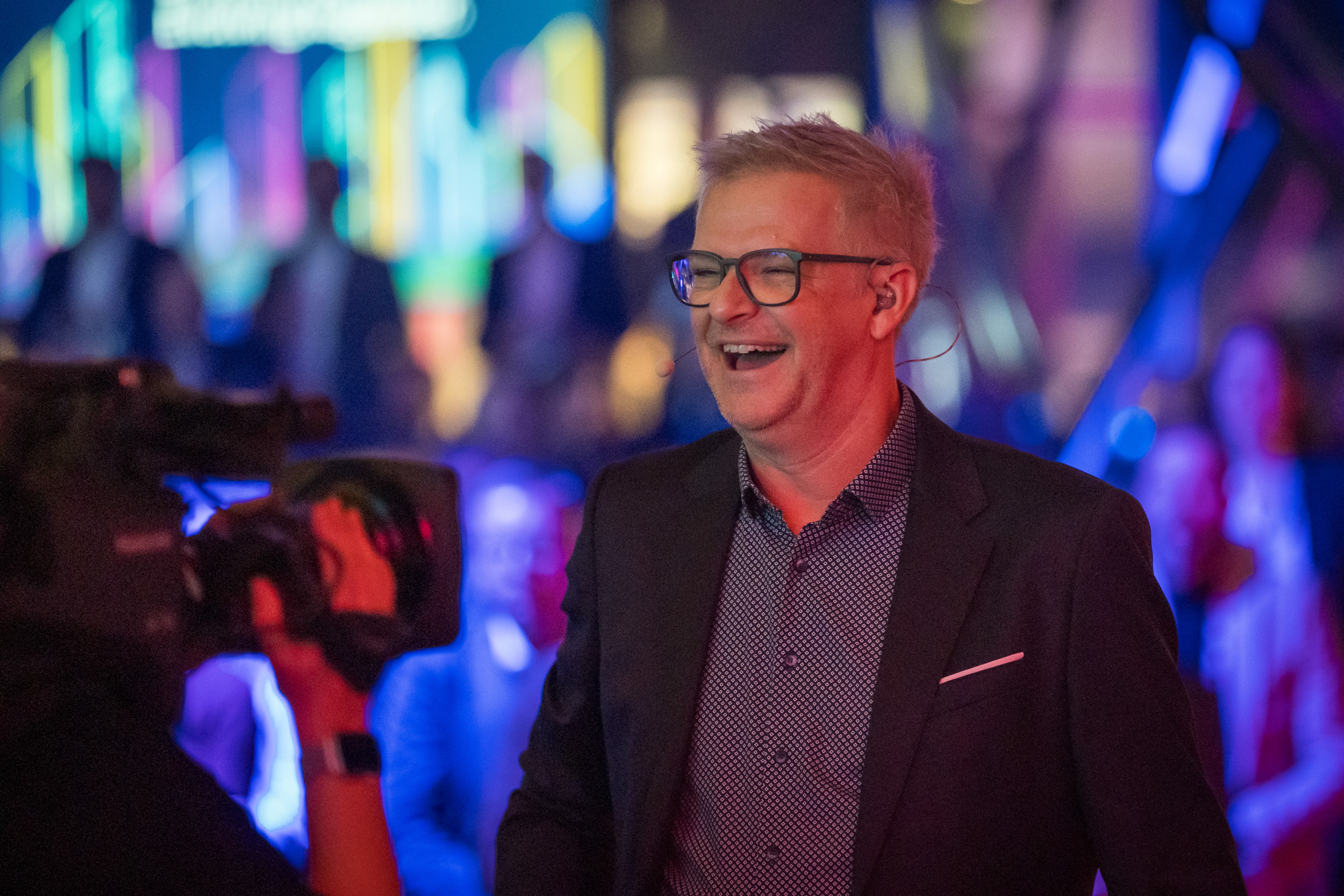
The role of the moderator
What is the role of a good moderator today?
For me, a good moderator provides guidance - both in terms of content and emotion. They maintain a common thread without becoming rigid, and ensure that the people on stage remain understandable, approachable, and relevant. As a moderator, I always try to be on equal footing with my conversation partners and set the stage for them to present themselves in the best possible light. Today, moderation is less about announcing and more about connecting: between content, people, and the audience.
How has this role changed in recent years?
Fortunately, the trend is moving more and more toward dialogue and away from the classic lecture. This is good for the audience AND the people on stage. Audiences are becoming more discerning and want to be engaged with topics that interest them - not with what the speaker wants to get off their chest. It's about showing attitude and allowing critical questions from time to time. When you open yourself up to the audience, it's a great advantage to have a moderator at your side who can steer and guide the discussion. Depending on how much focus is on the moderator, they can open or close a space – for everyone involved.
Preparation is everything
What does good preparation look like to you?
The question of why is often overlooked - and that's exactly what you notice later in the result. Incidentally, for me, this applies not only to moderation, but also to conception in particular.
For me, that means understanding before I lead. I want to know the goals of the event, the target audience, the role of the individual contributions, and the people on stage. Good preparation is not about learning a script, but about immersing myself in the content – so that I can be spontaneous later without seeming arbitrary.
What information do you need from the agency and client, and why? How do you use this information later on stage?
Above all, I need to know everything about the goal, context, and audience: What should be different after the event than before? Who is sitting in the room? What role do the individual program items play in the overall picture? This information helps me to create transitions, set priorities, and conduct conversations in such a way that they fit into the overall concept and always tie in with the "common thread."
This input gives me guidance on tone and dynamics. I can ask more specific questions, make connections, and react when something develops differently than planned. Good preparation creates confidence - and it is precisely this confidence that enables spontaneity. The more I know, the better I can respond to situations and react individually. Every insider tip is worth its weight in gold.
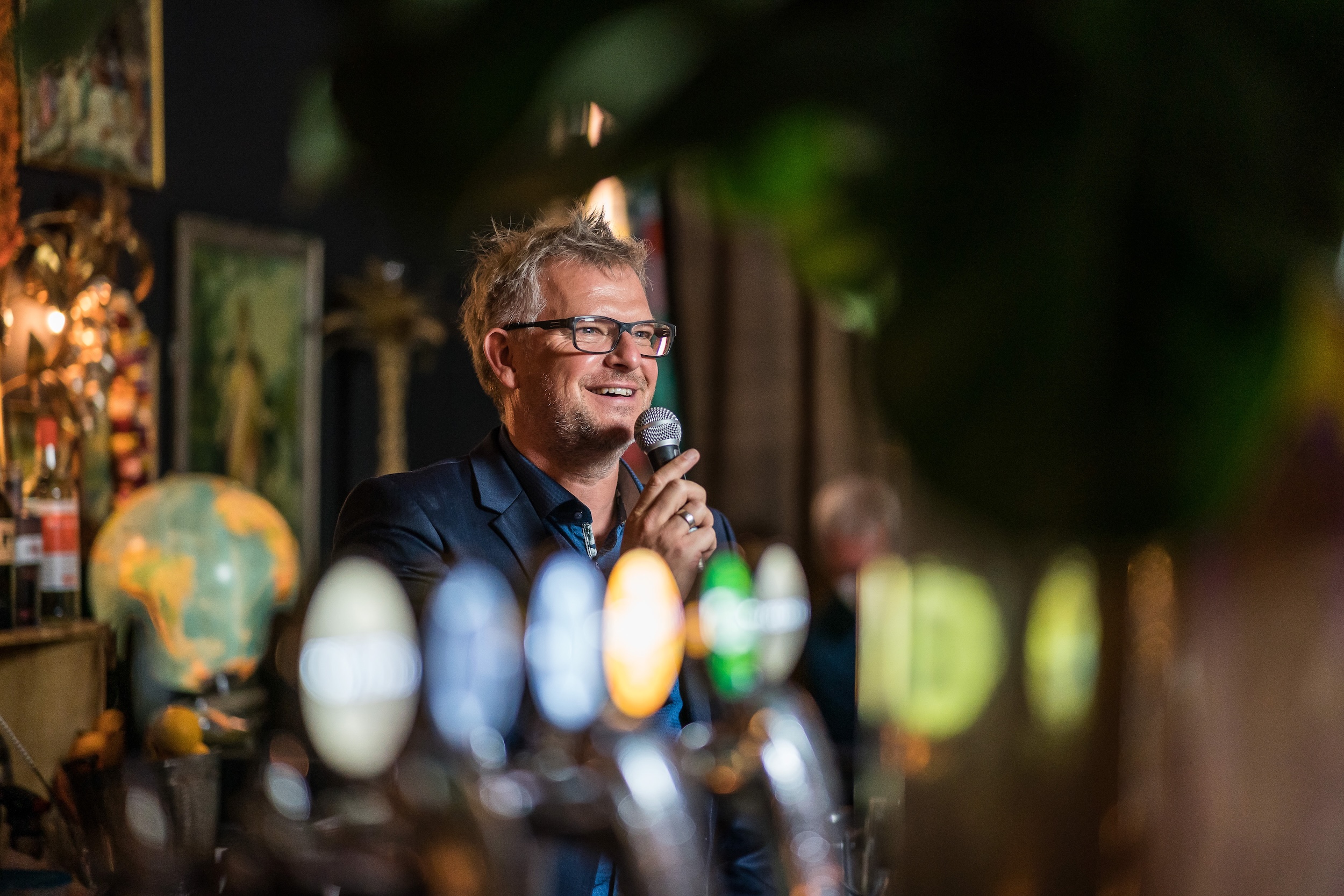
On stage
How does moderation support the central theme of an event?
Moderation is the visible and audible vehicle for this central theme. It connects program items, organizes content, and helps the audience recognize connections. Without this organization, contributions often stand alone - with moderation, they become part of a shared story.
Do you see yourself as a "translator" between the stage, the audience, and the content?
Yes, absolutely. I translate technical expertise into comprehensible language, moods into words, and sometimes even tensions into productive discussions. This translation work is one of the most important parts of good moderation.
Challenges on and off stage
What was one of the biggest challenges as a presenter?
One of the biggest challenges was my spontaneous return after the break. I got a call asking if I could take on a big event presentation at short notice - two days' notice, a complex context, a lot of responsibility. I had great respect, not only for the stage, but also for the situation.
I prepared myself on the train to Berlin, reading a lot and getting my thoughts in order. Once there, I met a strong team, including people from ottomisu, and rediscovered how important the interaction behind the scenes is for the people on stage. The calmness we radiate backstage is crucial for what happens on stage. When I perform with inner calm, it immediately transfers to the room and the audience.
How do you deal with delays, technical problems, or other spontaneous changes?
That's part of everyday life. It's important to stay calm and handle the situation transparently but confidently. The audience is forgiving if they feel well looked after. In moments like these, moderation creates security and structure - even when both are lacking in the process. Here, too, the same applies: a funny, spontaneous remark can usually shift the focus of the situation. One rule is definitely: NEVER complain about the technology. Firstly, they don't make mistakes out of malice, and secondly, they always have the upper hand.
Have there been situations that went completely differently than planned?
Oh yes. One of my most memorable was also my last show on Rhein-Main TV. We were taken off the air - too cheeky, too youthful, too abnormal for the producers. We had one last show to say goodbye, but nothing really planned. My idea was to invite a few companions from the station, tell stories from past shows, and then say goodbye.
Suddenly, guests from old shows came into the studio, while the studio was being dismantled in the background during the conversation. Cameras, sets, everything. In the end, I sat on the floor, the last guest had brought two crates of beer, we had a “ground party” as a demolition party – and at some point the lights went out. Cut. OUT.
The crazy thing is that the station broadcast everything. And the feedback from outside was excellent: “Finally something bold!” “Awesome, your demolition party!” – exactly the reactions we often wished we had gotten on regular shows.
What did you learn from this for future events?
That you have to be able to let go of control. Of course, you need structure, dramaturgy, a plan. But the magic often happens in the moments in between – when you're ready to respond to what's happening in the room. And sometimes it's precisely what “breaks the mold” that people remember later. Good moderation doesn't mean holding on to everything, but knowing when to lead and when to go with the flow.
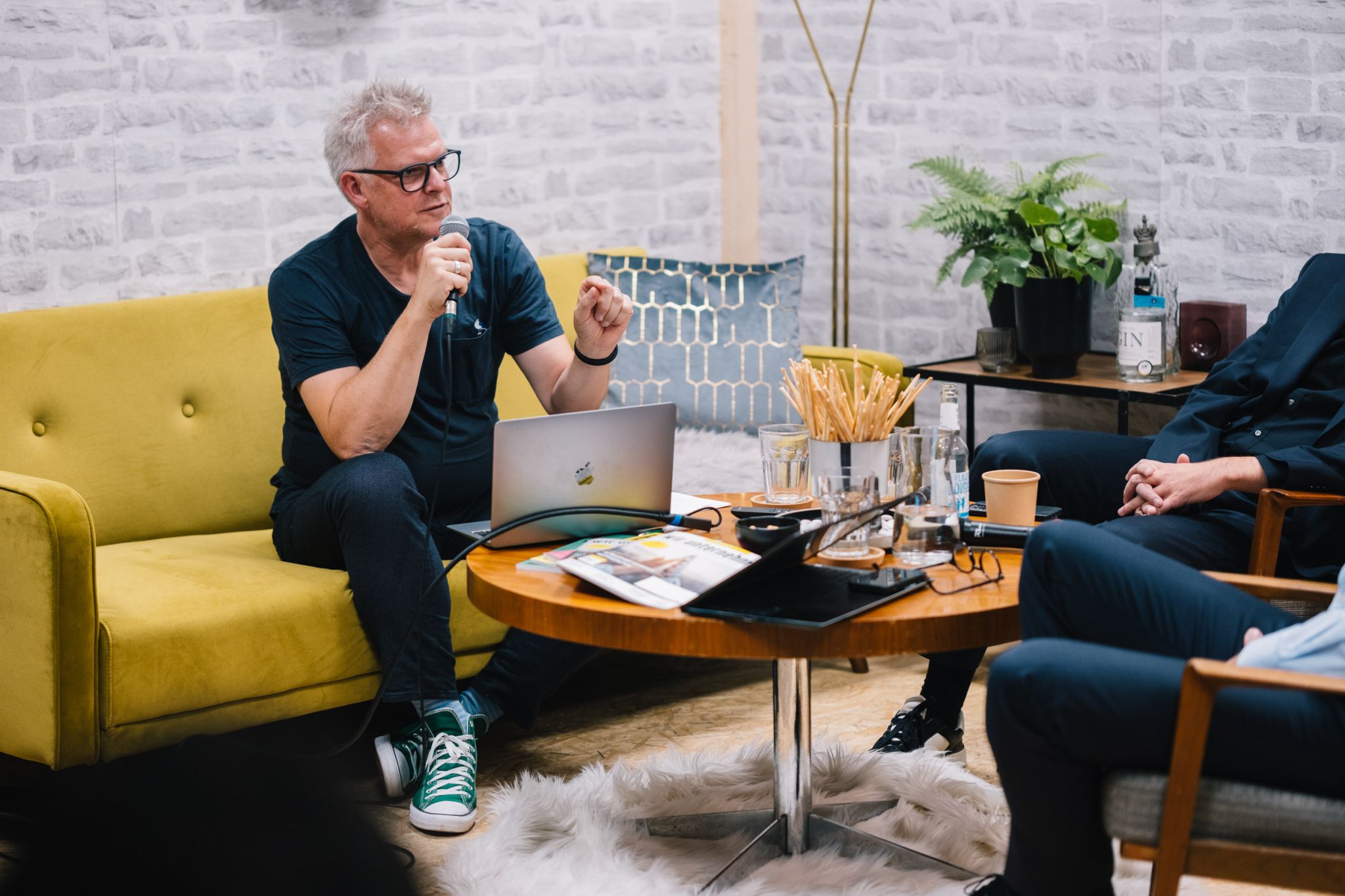
The future of moderation
Where is moderation headed, and why can't AI take over your job?
Because moderation is always about "real" relationships. It's about nuances, the mood in the room, glances, pauses, uncertainties – everything that happens between the words and between the participants. This human perception and situational awareness cannot (yet) be automated.
Which skills are becoming more important?
I am convinced that trends always trigger a countertrend. AI will become more and more prevalent in our lives, we will have more and more to do with digital creatures – and the urge for "real" people will become more valuable again. For me, this means that spontaneity, perception, and empathy make the difference. And for that, it is extremely important to be confident in the process and the content in order to have this openness and to perceive nuances. If you stick to the text or the teleprompter, there is no "freedom" for spontaneous reactions.
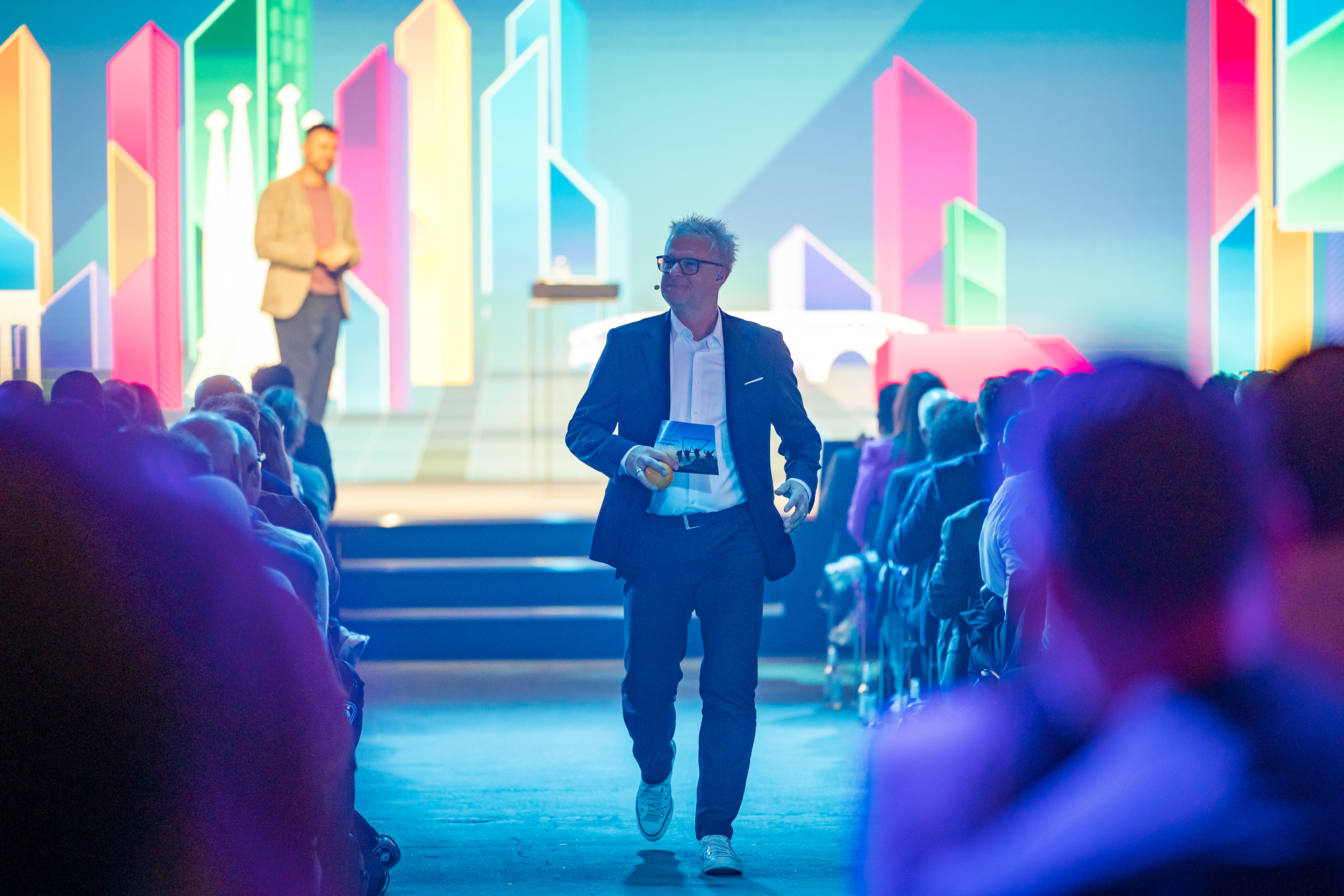
Thank you, Holger, for this exciting interview and your insights on the topic of moderation. Once again, it becomes clear how many areas have to work together if the transformative power of events is to be used properly. One of these is definitely the appropriate use of good moderation with structure, spontaneity, and a whole lot of enthusiasm and excitement that fills the room! We look forward to seeing you again soon on an event stage.
About Holger Erdrich
Moderator, Concept Developer & Event Specialist
Holger Erdrich has been developing and moderating analog, digital, and hybrid events for over 25 years. As a moderator, he accompanies events and shows that combine attitude, structure, and humor. In addition to his stage work, he designs and implements event formats, advises on innovation processes, and supports teams in creative development.
Focus areas: moderation of events, conception of live and hybrid events, event planning & event production, innovation consulting, development of creative teams.
Learn more: LinkedIn, Conception, Moderation