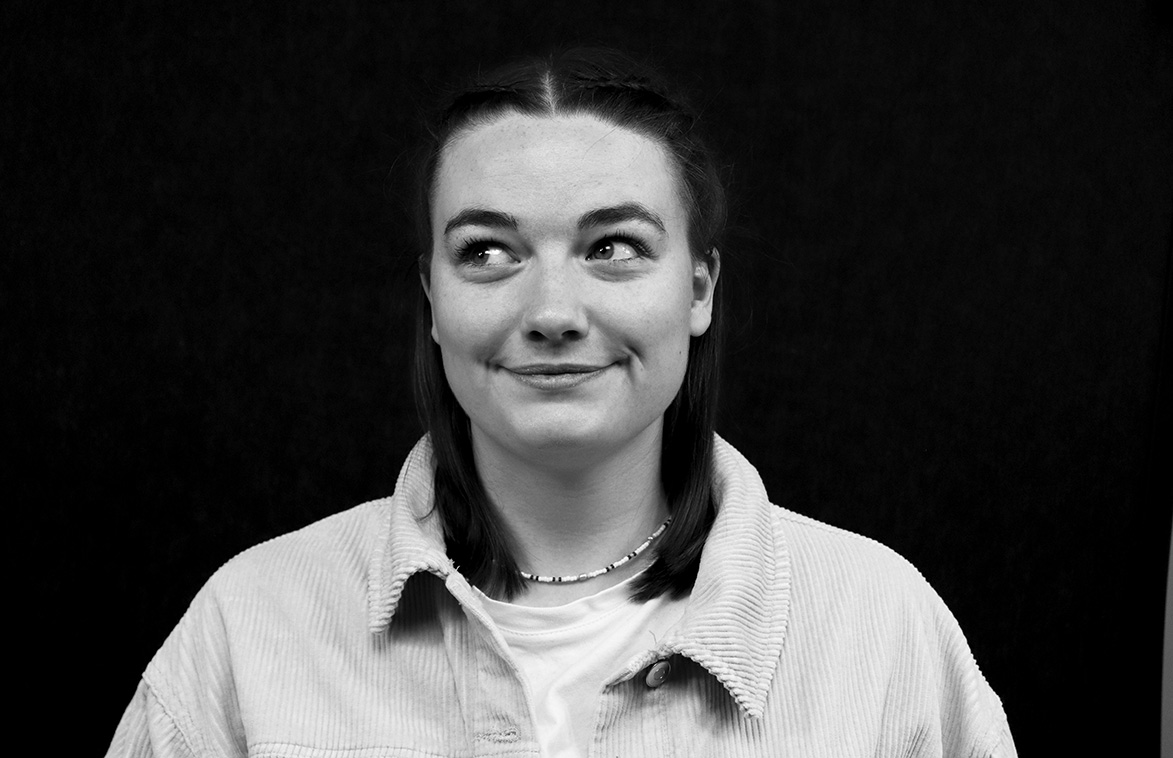


Exploring creativity with Chris Cuhls
by Beke Alberring
What exactly is creativity, and where does it hide when we need it most? Between flashes of inspiration and deadlines, intuition and structure, genius and madness, there is a space that holds a lot of potential – if you approach it with curiosity. As a production director, staging professional and creative enabler, Chris Cuhls knows how to spark creativity in this space.
Our Beke is always on the lookout for creativity in the areas of content, creation and design, and wanted to know from him what creativity means to him, how it arises and how to approach it in a targeted manner. Chris's answers take us through thought processes, changes of perspective and high above the clouds.
Creativity in everyday life
Beke: Chris, what does creativity mean to you personally?
Chris: Broadly speaking, creativity can solve any problem in the world. It allows us to defy insignificance. In live communication in particular, it enables us to bring something to life that inspires and transforms people.
Beke: What inspires you and when do you feel most creative?
Chris: I find inspiration everywhere: in music, in conversations, in nature, in art, in museums... Often it's not the ‘big’ sources, but small everyday moments with my children or simply life itself, with little details that suddenly set a story or a drama in motion. Whenever I feel that inner tingling sensation, I'm on the right track...
I feel particularly creative when I am completely at peace with myself and my head is clear for new ideas. This inner connection helps me to create something original. Such moments often arise when I am running, in the sauna, talking to people who think differently or when I am flying. I recently completed my pilot's licence and I must say, the perspective from above is indescribable and leads to extraordinary things. Sometimes, however, a walk around the block, a song at full volume or a conscious ritual of putting away your mobile phone is enough. And of course, deadlines are always a booster. 😉
Processes and methods
Beke: How do you approach a new creative project? Do you have a specific approach?
Chris: First, I always want to find out: What should be different afterwards than before? What do we want to achieve? Then I move on to stakeholder analysis: What is really important to those involved? Where is there an overlap between the sender's concerns and the recipient's interests? This space can then be creatively designed as a basis. Sometimes disturbing – to wake people up. Sometimes touching – to connect. Whatever seems appropriate.
Beke: Are there any tools or methods you regularly use?
Chris: Actually, nothing spectacular – in the end, it's just the synapses in the brain firing. You can't do it without them. Above all, I think conversations with experts from the network help me the most. And then it's just notes and later a storyboard that combines structure and emotion. I often start with three columns on paper: facts, emotions, open questions. That alone creates structure and opens up space for playfulness. When it comes to user perspectives, design thinking elements also help.
Beke: What do you do when you get stuck? When the creative flow stops and your synapses aren't firing on their own?
Chris: Let go and relax. Just go outside and get some distance. It often helps to talk to someone who has nothing to do with the matter – that's often where the best ideas come from. When I get stuck, I do something very simple: I change my perspective by telling my children about the idea. If they don't understand a word of it, I know I have to go back to the drawing board.
Creative teamwork
Beke: What constitutes a creative environment for you, and what do you need to be able to work creatively in a team?
Chris: For me, it's a place where ideas aren't immediately evaluated, but rather developed further. Where people play ping pong. Where I'm allowed to be a little crazy before things are sorted out. A place where you can be curious and where contradiction is allowed. It is only through vulnerability that we arrive at results that later touch people. This also means throwing an unfinished idea into the ring before it sounds perfect. This often opens the door to new ideas. I believe it helps if we are in tune with our own emotions. When we share them openly, we arrive at completely different results. Friction is definitely part of it, otherwise it remains superficial. It's good to inspire each other and incorporate different perspectives. As Anais Nin said, ‘We don't see things as they are, we see things as we are.’ That's okay, but it's also limiting. We also need to look at things from other perspectives. Whether from the technician, the costume designer or the programmer. My perspective and life experience are limited – so I can only grow beyond myself to a limited extent. We need each other for excellence.
Creativity and AI
Beke: Have you already worked with AI tools in the field of creativity? If so, how and for which tasks?
Chris: Sure! At first, I was incredibly frustrated with the results from Chat GPT & Co. They don't produce ready-made concepts – you still need professional judgement, which makes all the difference. But in the meantime, you learn how to prompt it, and lo and behold, AI provides great support for brainstorming, text or image inspiration. I use AI in a very practical way to come up with headlines. When I see five variations, I often realise for myself which direction really works. As a creative sparring partner, I wouldn't want to be without AI anymore. In any case, AI is a time booster that frees up space for further thinking.
Beke: I believe that AI can save us a lot of time when used correctly in many areas. In the field of creativity, is AI a competitor that will soon replace creative thinking, or is it a creative catalyst that complements it?
Chris: AI replaces mediocrity – and that's a good thing. Beyond that, it complements. AI can deliver, but it has no inner compass. What emotion do I want to evoke in the audience? As a director, I have to bring that empathy to the table.
Beke: Specifically, what was a particularly surprising moment with AI?
Chris: Recently saw the results of clips created by VEO3. AI generated character-consistent advertising based on a few short prompts – crazy!
Creativity in conception
Beke: You are not only a process director, but also involved in some conceptual work. How do you find your way into a new concept – through research or intuition? Do you have certain rituals or environments that help you think?
Chris: First, I start with analysis. Solid research is also part of it. And then it's intuition: what could catch on, what is appropriate and what will get us to our goal? You could also follow certain processes here – but that's the beauty of creativity: it can be wild! Combining things seemingly at random and following your own intuition. That doesn't really require external space, but rather freedom of inner space. Going to places that didn't exist before and then bringing them into reality. In practical terms, what helps me is closing my laptop and opening my notebook. As soon as I start scribbling by hand, my mind shifts into a different gear. This requires me to stop scrolling through infinity.
Beke: After the start, the question of the end eventually arises. When is an idea ‘complete’ for you?
Chris: When it appeals to the head, the heart and the hand. Preferably without words, because we connect with our intuition and it stimulates something deep within us. What it moves us to do is always in the eye of the beholder.
Beke: How do you deal with criticism of your concepts – does it inspire you or slow you down?
Chris: Of course, it's not always easy to take. But when it's phrased constructively, it's helpful. Criticism forces you to become sharper.
Beke: Finally, to ask you quite openly: what have you always wanted to say about creativity?
Chris: Have courage – every person is creative. Creativity is not a talent, but an attitude. It's about staying curious, tolerating contradiction and courageously creating moments together that have an impact. Consciously try small experiments in everyday life – ask an unusual question in meetings or try a crazy sequence of steps in a process. Creativity grows when we allow ourselves to make mistakes. Then, in the end, it's really fun to develop something new!
Beke: That's the perfect conclusion! Thank you, Chris, for the exciting insights into your way of thinking, as well as your tips and tricks on how you personally keep getting back on track with creativity.
Wer noch mehr von und über Chris wissen möchte, schaut am Besten bei seinem Podcast vorbei. Hier gibt es jede Menge Folgen mit spannenden Gästen!
About Chris Cuhls
Event Director, Concept Developer & Consultant
Chris Cuhls has been developing and directing analog, digital, and hybrid events for over 20 years - ranging from corporate formats to large-scale show productions. As an event director, he ensures precise workflows, clear dramaturgy, and impactful moments. In doing so, he combines conceptual strength with a keen sense of timing, detail, and overall impact. In addition to his directing work, he advises companies and agencies on the strategic conception of live communication and sees himself as a creative sparring partner for impactful event formats. His focus is on staging relevant messages in a way that leaves a lasting impression on the mind, heart, and action. 
Focus areas: Event direction & scheduling, planning of live and hybrid events, dramaturgy & staging, consulting on effective event formats, development of creative event concepts